If you want to see what “money on-chain” actually looks like in production—not just in whitepapers—watch Singapore this week.
At the Singapore FinTech Festival, the Monetary Authority of Singapore (MAS) did three things that, together, amount to a live-fire rehearsal for a new kind of financial plumbing:
- It completed the first live settlement of interbank overnight loans using a wholesale CBDC (a “digital Singapore dollar” issued by the central bank) between DBS, OCBC and UOB.
- It said it will pilot tokenised MAS bills in 2026, effectively putting Singapore’s risk-free short-term debt on-chain as programmable collateral.
- It confirmed that Singapore’s tailored stablecoin regime will come into force around mid-2026, turning certain SGD and G10-pegged stablecoins into fully regulated, bank-like “money tokens”.
Most headlines will reduce that to “Singapore runs another CBDC pilot.” But look a bit closer and you see something more ambitious: Singapore is trying to make three different forms of digital money—CBDC, tokenised bank deposits and regulated stablecoins—interoperate on the same rails, with tokenised government bills as the anchor collateral.
For investors and founders, that’s a big deal. It hints at how wholesale payments, corporate treasury and even retail wallets might work once money is as programmable as the rest of the internet.
What MAS Just Switched On (In Plain English)
Let’s start with the concrete moves.
1. A live wholesale CBDC on the “SGD Testnet”
MAS announced that it has settled real overnight interbank loans—the short-term funding banks use to square their daily positions—using a wholesale central bank digital currency (CBDC) on an “SGD Testnet”.
Wholesale CBDC is not a retail coin you or I spend. It’s central bank money for banks, represented as tokens instead of balances in traditional RTGS systems. For MAS and the three local banks, this trial showed:
- Near-instant settlement of overnight loans
- Atomic delivery-versus-payment (DvP) between banks
- A programmable way to enforce collateral rules, haircuts and maturities
The next step, MAS says, is to extend that testnet to settle trades in tokenised MAS bills using the same wholesale CBDC, essentially creating an on-chain, risk-free repo market.
2. Tokenised MAS bills as “risk-free” money-market tokens
MAS bills are short-dated Singapore government securities; they are the equivalent of U.S. T-bills for Singapore’s money markets.
Tokenising them means:
- Each bill (or fraction of it) is represented as a digital token on a permissioned ledger
- Ownership and settlement can be updated programmatically, 24/7
- They can be used as collateral in smart contracts, including for repo, margin and liquidity facilities
Put differently, MAS is turning the safest assets in the system into programmable building blocks. That’s a foundational move if you want serious institutions to bring real-world exposure on-chain.
3. Stablecoins: From “crypto” to regulated money tokens
MAS actually finalised its stablecoin framework back in 2023, targeting single-currency stablecoins (SCS) pegged to SGD or any G10 currency and issued in Singapore. The framework demands:
- High-quality reserve backing (cash and short-term sovereign and quasi-sovereign assets)
- Segregation of reserves and daily reconciliation
- A T+5 redemption right at par for holders (five business days)
- Clear disclosure of risks and governance
This regime is expected to take legal effect around mid-2026, aligning nicely with the MAS bills tokenisation timeline.
Crucially, this is not a crypto free-for-all. The framework covers only SGD and G10-pegged coins that meet strict criteria; everything else stays under Singapore’s wider “digital payment token” regime or securities rules.
Three Kinds of “New Money” — One Stack
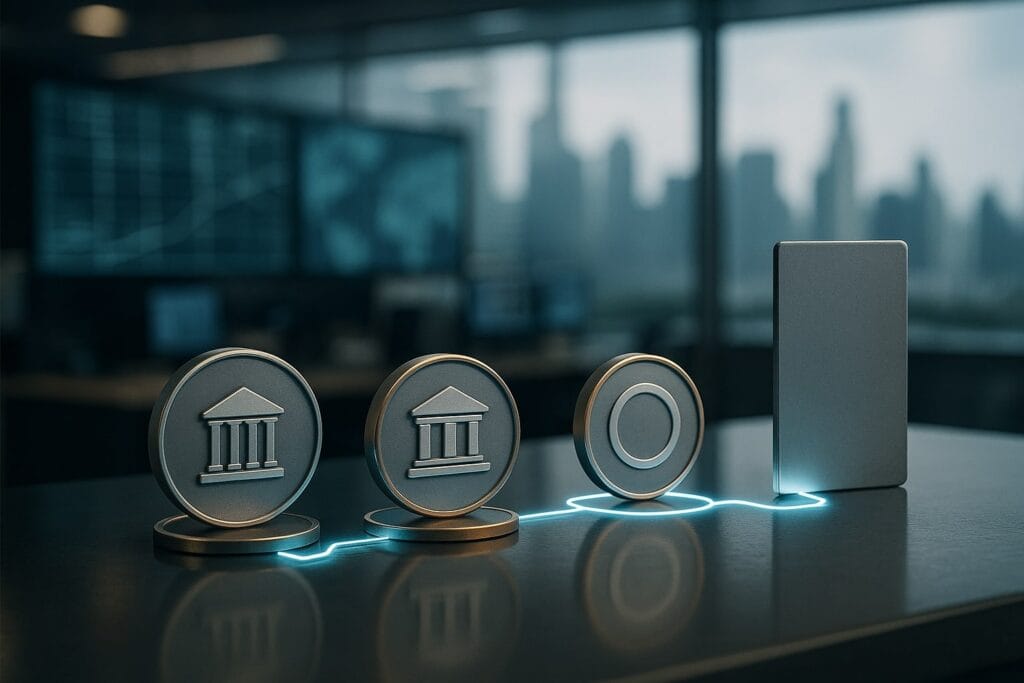
Put those pieces together and you get three flavours of institutional-grade “on-chain money” that MAS is trying to connect:
- Wholesale CBDC – central bank liabilities for interbank settlement (the “base layer”)
- Tokenised bank deposits – deposits represented as tokens on authorised ledgers (the “commercial layer”)
- Regulated stablecoins – fully reserved tokens issued by licensed entities (the “open interface” layer)
Around this, MAS and industry partners are also building:
- Tokenised MAS bills as the canonical risk-free collateral
- Tokenised funds and bonds under Project Guardian, which is MAS’s umbrella programme for asset tokenisation pilots, involving more than 40 institutions.
It’s effectively a blueprint for a tokenised financial stack:
- Base money (CBDC)
- Bank money (tokenised deposits)
- Non-bank money (regulated stablecoins)
- Collateral and investment assets (bills, bonds, funds)
All of it running on interoperable, programmable ledgers rather than siloed mainframes and messaging networks.
This idea is not unique to Singapore. Just this week, JPMorgan began offering a USD deposit token (JPM Coin / JPMD) on public blockchain infrastructure to institutional clients, promising 24/7 settlement of large-value payments.
But where many jurisdictions are still debating whether deposit tokens and stablecoins should exist, Singapore is quietly moving to make all three categories interoperable under one regulatory and technical umbrella.
Why Singapore? The City-State as “Money Testnet”
There are structural reasons Singapore is well-suited to this role.
- Size with systemic relevance
Singapore is big enough to matter—an FX hub, a wealth-management centre, a key node in Asian trade—but small enough to move relatively fast without systemically destabilising the global financial system if something goes wrong. - Regulatory clarity as an export
MAS has spent the last few years licensing crypto service providers, tightening rules for retail access, and rolling out a layered framework for tokens that are payment instruments, securities, or something in between.
That makes it one of the few jurisdictions where banks, asset managers and fintechs can operate tokenised products with some confidence about the rules. - Project Guardian as a coordination tool
Instead of letting every bank run its own siloed experiments, MAS uses Project Guardian to co-ordinate pilots in FX, fixed income, funds and cross-border settlement, with common technical standards like the Guardian Composable Token Taxonomy. - Deliberate cross-border partnerships
The latest announcements also include joint work with the Bank of England, Bank of Thailand and the Deutsche Bundesbank on cross-border digital asset and FX experiments.
That’s subtle but important: Singapore is not building a walled garden; it’s positioning itself as neutral ground where different central banks and banks can test interoperability.
For investors, the message is clear: MAS is not just supervising tokenisation from the sidelines; it is designing the reference architecture that other markets may borrow.
What Changes for Banks and Corporate Treasurers?
From a bank or treasurer’s point of view, this is not about NFTs or consumer crypto at all. It’s about balance sheet mechanics and liquidity.
1. Interbank markets that run at internet speed
Today, interbank overnight markets still depend heavily on RTGS systems and batch processes. With wholesale CBDC:
- Intraday and overnight lending can settle in seconds, not hours
- Collateral can be moved and re-optimised programmatically
- Counterparty and settlement risk can be reduced, freeing up capital
That translates into more efficient liquidity coverage ratio (LCR) management, lower liquidity buffers and potentially better loan pricing.
2. Programmable collateral for repo and derivatives
Tokenised MAS bills create the possibility of:
- On-chain repo, where the collateral automatically returns when a loan is repaid
- Smart margin calls for derivatives that respond in near real time to price changes
- Cross-venue portability of collateral, as long as the venues share a common standard or interoperability layer
For treasurers, that could mean fewer fragmented pools of “trapped” collateral and less reliance on manual reconciliations and phone calls.
3. Stablecoin rails for B2B payments and trade
Once the stablecoin regime is in force and a few large, MAS-regulated stablecoins exist, corporates could:
- Use SGD or USD-pegged stablecoins issued under MAS rules for B2B payments, treasury sweeps and intra-group liquidity
- Settle trade finance flows and supply-chain invoices on-chain, especially when combined with tokenised trade documents and receivables
- Tap into cross-border corridors where foreign partners hold compatible tokens under their own local rules
The combination of tokenised deposits + MAS-regulated stablecoins + tokenised bills gives banks a full spectrum of tools to offer “on-chain cash management as a service”.
Where Startups and Fintechs Plug In
If Singapore is the testnet, where’s the opportunity for fintech and startups?
1. Compliance and risk infrastructure
As soon as money moves on new rails, regulators want:
- Transaction-level AML/CFT monitoring
- Real-time travel-rule and data-sharing capabilities
- Tools to spot cross-chain and cross-asset abuse
That’s an opening for startups building “RegTech for tokenised finance”—systems that can ingest on-chain events from multiple ledgers, correlate them with off-chain KYC data, and feed banks’ risk engines in near real time.
2. Middleware for legacy systems
Most banks and corporates will not rip out their ERPs and core banking systems. They will need:
- Middleware that translates SWIFT messages, ISO 20022 flows and core-banking entries into token operations
- Treasury dashboards that abstract away chain IDs, wallet formats and key management
- Secure custody and key orchestration layers for institutions
Think of this as “Stripe for tokenised money”, but for banks and mid-market corporates, not internet merchants.
3. Verticals: trade, fund distribution, capital markets
Project Guardian already features pilots in:
- FX and cross-border payments
- Tokenised funds and wealth products
- Bond issuance and distribution
Each of those areas is ripe for vertical fintech plays:
- Trade-tech platforms that embed tokenised settlement into letters of credit, invoices and bills of lading
- Wealth platforms that let advisers allocate into tokenised funds and treasury instruments with instant settlement
- Market infrastructure vendors that build issuance and lifecycle platforms for tokenised bonds and structured products
4. Cross-border interoperability layers
Finally, there is room for neutral players that help:
- Route and translate between Singapore’s token standards and those of the UK (FCA fund tokenisation blueprint), the EU, Hong Kong and the U.S. GENIUS Act regime.
- Manage FX, liquidity and compliance when a payment starts as tokenised deposits in one jurisdiction, crosses as stablecoins, and settles against tokenised bills in another.
That’s not a seed-stage “we have an app” story. It’s a deep infrastructure play suited to teams that know both banking and protocols.
The Global Race: Singapore vs the U.S., UK and Hong Kong
Singapore isn’t alone in chasing tokenisation.
- In the United States, the GENIUS Act created a federal regime for payment stablecoins in mid-2025, and banks like JPMorgan have launched deposit tokens, tokenised funds and on-chain payment services via its Kinexys platform.
- In the UK, the FCA is consulting on fund tokenisation (CP25/28) and has authorised its first tokenised UCITS under a “Blueprint” model, with on-chain unit registers but conventional cash settlement—for now.
- In Hong Kong, a new stablecoin regime took effect in August 2025, setting out licensing and prudential requirements for fiat-referenced stablecoins.
What’s different about Singapore is that all three layers of money (CBDC, deposits, stablecoins) and core collateral (MAS bills) are being designed together, with:
- A single regulator orchestrating pilots via Project Guardian
- A cluster of large local banks (DBS, OCBC, UOB) willing to run real balance sheets through these systems
- Explicit cross-border collaboration baked into the roadmap
If the U.S. is where the biggest balance sheets and capital markets are, Singapore is increasingly where the architecture is being prototyped.
Risks, Frictions and the Non-Zero Chance of Boredom
Tokenised money is not an automatic win.
- Interoperability risk: If each jurisdiction and bank builds slightly different token standards, you end up with new silos on new rails. MAS’s taxonomy work helps, but it doesn’t control London, New York or Hong Kong.
- Operational and cyber risk: Wholesale CBDC and tokenised bills concentrate a lot of value in programmable systems. Bugs, misconfigured smart contracts or compromised keys could have outsized consequences.
- Political risk: Tokenised money touches central bank mandates, data sovereignty and sanctions policy. That can change with elections and geopolitical shifts.
- Adoption friction: Many corporate treasurers simply care about cost, speed and predictability, not whether their cash sits in a “wallet” or a “custody account”. If tokenised rails fail to deliver clear economic benefits, they may quietly stall.
There’s also a more mundane risk: that after all the hype, tokenisation feels like just another round of back-office upgrade—hugely important for margins and risk, but not particularly sexy.
For investors, that may actually be the point. Once tokenised money feels boring, it’s probably working.
The Bottom Line: Treat Singapore as a Forward Indicator
For investors, the signal is that tokenisation is no longer just a narrative. A G20-adjacent financial centre is:
- Putting real wholesale funding flows on-chain
- Turning its safest assets into programmable collateral
- Locking in a regime for regulated stablecoins with a clear timeline
The investable themes are less about “the next crypto app” and more about:
- Infrastructure and middleware that lets banks, asset managers and corporates join these rails
- Compliance and risk tooling that makes regulators comfortable with scale
- Interoperability layers that connect Singapore’s stack to other regimes
For founders, Singapore is your live reference deployment. If your product:
- Helps banks and corporates move between legacy and tokenised rails
- Makes it safer or cheaper to run balance sheets on those rails
- Or connects Singapore’s experiments to other big markets
…then you should be studying what MAS is publishing, which pilots get promoted out of the sandbox, and how local banks are actually using the “SGD Testnet” in production.
The key takeaway is simple: money is becoming an API layer you can program against, not just a balance in a database. Singapore is where a lot of that code is being written first.
If the 2010s were about fintech apps on top of old pipes, the late-2020s are shaping up to be about rebuilding the pipes themselves. Singapore is quietly volunteering to be the world’s testnet for that shift—and the rest of the world will be watching, and eventually, copying.