Revolut has never had trouble with the consumer part of consumer finance. Its pitch—one app, many money jobs—travels well. FX, cards, subscriptions, crypto (where allowed), business accounts, travel perks: the “super-app” narrative works across borders.
What hasn’t traveled as easily is the part regulators care about most: the license that makes you a bank, with all the unglamorous obligations that come with it.
On March 5, Revolut filed for a U.S. national bank charter and FDIC deposit insurance, and named Cetin Duransoy (formerly Visa) as its U.S. CEO. Revolut says it plans to invest $500 million in the U.S. over the next three to five years across marketing, hiring, and bank capitalization.
If approved, the application would mark a pivot from “we partner with a bank” to “we are the bank.” And that’s not a subtle change. It’s a new business model, a new cost structure—and a new kind of scrutiny.
The numbers behind the ambition
Here’s what Revolut is bringing to the table:
- ~70 million customers across ~40 markets, with a stated goal of 100 million.
- A valuation of $75 billion, reinforced by a completed secondary share sale.
- A profitable engine: in 2024, Revolut reported $4.0B revenue and $1.4B profit before tax (with customer balances rising to $38B).
- Momentum heading into 2025: Revolut says its global retail customer base surpassed 65 million, and Revolut Business reached $1B annualized revenue.
- A foothold in the U.S. already: about ~0.5M retail users and ~0.5M small-business customers, according to executives speaking to the press.
Those are serious inputs. The missing piece is the right to hold insured deposits in Revolut’s own name—without renting the plumbing from a partner bank.
Why a charter matters when you already have an app
A U.S. bank charter isn’t just a regulatory trophy. It’s a set of economic levers Revolut can’t fully pull today.
1) Deposits as product, not pass-through
Partner-bank arrangements can work—until they don’t. When your checking account is technically someone else’s deposit product, you inherit their limitations: how fast you can ship features, how you price savings, and how much control you have over the customer relationship.
A charter is a claim on permanence. You stop being a guest in another bank’s house.
2) The “payments economics” flywheel
In the U.S., the unit economics of cards can be unusually attractive—especially if you’re small enough to sit below certain regulatory thresholds, at least initially. For debit cards, Regulation II caps interchange fees only for “covered issuers” (generally large banks), using a formula tied to transaction size.
Revolut’s bet is straightforward: build a primary account, route more spend, and monetize through the blend of interchange, subscriptions, FX, and add-on services that already works elsewhere.
3) Lending without the “funding tax”
Revolut has signaled it wants to offer deposits, loans, credit cards and payments in the U.S. once approved. A charter can reduce reliance on wholesale funding and partner-bank constraints—key if you want to scale lending products (even modestly) at U.S. marketing-cost levels.
In short: if Revolut wants to be a full-service U.S. financial institution, a charter isn’t optional—it’s foundational.
The catch: charters are moats and muzzles
Becoming a bank is like buying a toll road: the cash flows can be wonderful, but the rules are relentless—and someone is always checking the cameras.
The American regulatory mood music has been shifting in two directions at once:
- More openness to new entrants (including fintech and digital-asset infrastructure), with a visible pipeline of charter activity. Banking industry reporting noted a surge in OCC filings—at least 18 applications filed with the OCC last year, with momentum continuing into 2026.
- More intolerance for “rent-a-bank” ambiguity, especially where third-party fintech relationships blur accountability.
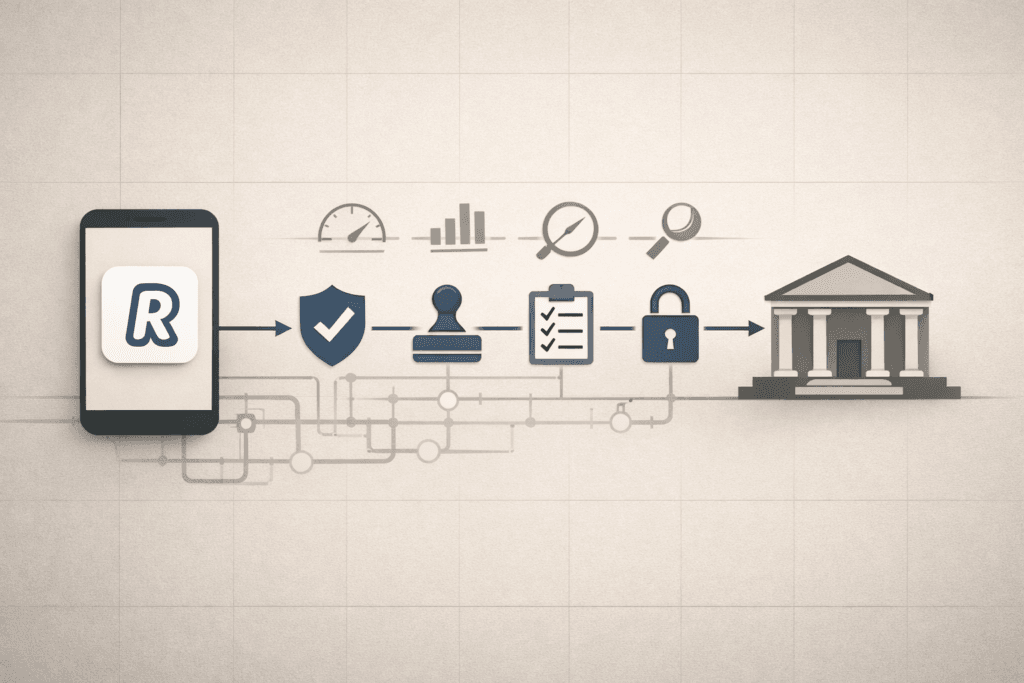
That second point matters because Revolut is essentially asking regulators to trust that it can run a U.S. bank with the controls, governance, and compliance maturity of a large incumbent—while still moving like a product company.
U.S. regulators have been explicit about where they think things go wrong. In 2024, the acting Comptroller of the Currency warned that in fintech-bank partnerships, “risk accountability” can become unclear when multiple entities with different incentives are involved. The agencies have also issued guidance and joint statements on third-party arrangements (the exact scaffolding that powers much of U.S. fintech).
So the question for Revolut is not “Can you acquire U.S. customers?” It’s:
Can you prove to U.S. regulators that your control environment is bank-grade—day one?
Why now? Follow the regulatory gravity, not the marketing plan
Revolut has flirted with U.S. bank access before, including acquisition discussions; as recently as January, reporting noted it had abandoned a U.S. bank acquisition path in favor of pursuing a standalone license.
The timing now looks less like a whim and more like a convergence of pressures:
Sponsor-bank dependence is getting more expensive
When regulators tighten standards around third-party arrangements, the indirect effects show up everywhere: contract renegotiations, compliance overhead, product delays, and sometimes abrupt relationship terminations. This doesn’t kill the model—but it makes it harder to build a global-scale consumer brand on top of it.
Charters are back in motion
The OCC has continued to process digital-asset and trust-bank charter activity, including conditional approvals for multiple digital-asset trust banks in late 2025. Even if those aren’t the same as a full-service retail bank charter, the signal is clear: the pipeline is not frozen.
Revolut is trying to “earn the right” to be regulated
A $75B valuation and sustained profitability give Revolut a story it didn’t have in earlier attempts: capital strength, scale, and a financial cushion. Regulators don’t approve charters because a company is famous—but they do care whether a bank can survive stress without becoming a supervisory emergency.
The UK contrast is uncomfortable
Revolut received a UK banking license with restrictions and entered a mobilisation phase, but still hasn’t fully graduated into a normal UK bank operating model. In the UK, restrictions have reportedly limited deposits and delayed lending rollout.
There’s a slightly awkward subtext here: Revolut is asking U.S. regulators for a full bank license while it remains partially constrained in its home market. That doesn’t doom the U.S. application. But it raises the evidentiary bar: Revolut will need to show U.S. supervisors that the lessons from other jurisdictions are embedded—not merely promised.
“But SoFi did it.” Yes—and the path matters.
It’s tempting to compare Revolut’s move to SoFi’s, because both are consumer-facing fintech brands aiming to become full-service banks. But SoFi’s route was different: it became a bank through acquiring an existing nationally chartered bank (Golden Pacific), with regulatory approvals tied to that transaction.
Revolut is pursuing the harder, slower path: a de novo charter plus FDIC deposit insurance, with the associated governance buildout and supervisory runway.
History is instructive here. Varo—often cited as the first consumer-focused fintech granted a full-service national bank charter—navigated a multi-year process that required serious capital and operational investment.
Revolut has more scale than Varo did, and arguably more product sophistication. But scale can cut both ways: the bigger you are, the more a regulator worries about what happens if you stumble.
What regulators will want to see (beyond the glossy deck)
A charter application is ultimately a credibility test across a few unsexy dimensions:
- BSA/AML and sanctions controls that can withstand growth
- Operational resilience (fraud, disputes, outages, vendor risk)
- Governance: independent oversight, risk committees, audit maturity
- Consumer compliance: complaints, error resolution, UDAAP risk
- Business plan realism: growth projections that don’t require miracles
These aren’t “startup problems.” They’re bank problems. And U.S. supervisors have repeatedly signaled they won’t lower the bar just because a fintech has a great UI.
That’s why this filing is so interesting: Revolut’s core advantage has always been product velocity. The banking system rewards patience, documentation, and control.
The charter Revolut wants could be the thing that forces it to grow up—fast.
Three scenarios for what happens next
Scenario A: Revolut gets the charter—and becomes a real U.S. bank brand
In this world, Revolut uses its capital, profitability, and global playbook to build a U.S. primary account that feels modern, priced aggressively, and scales into lending responsibly.
If this happens, it’s not because the app is better. It’s because Revolut convinces regulators that its risk culture is.
Scenario B: Approval arrives, but slowly—and Revolut remains “bank-adjacent” for years
This is the most common outcome for ambitious entrants: regulators take their time, the business continues under existing partnerships, and the charter becomes a medium-term option value rather than an immediate transformation.
Revolut can still grow in the U.S. here—but the economics and feature roadmap remain constrained.
Scenario C: The application stalls or fails—and the strategy flips again
Revolut has already demonstrated it can pivot paths (acquisition vs. standalone licensing). If regulators push back, the company may revert to acquisition, deepen partnerships, or refocus growth where licensing is clearer.
None of these scenarios are existential. But only the first makes Revolut a truly durable U.S. institution.
The thought-provoking question: Is Revolut ready to trade speed for legitimacy?
A bank charter is the opposite of a growth hack. It’s an agreement to play a long game under constant inspection.
Revolut is telling the U.S. it’s ready for that. The $500M investment plan, the leadership change, and the choice to pursue both OCC chartering and FDIC insurance say the company wants to be taken seriously as a regulated institution—not just a clever interface.
Now comes the hard part: proving that the world’s most ambitious consumer fintech can also become the kind of boring, well-controlled organization regulators trust with insured deposits.
In the U.S., the prize is huge. But the referee is stricter than the crowd.