Wise is approaching Wall Street with a profile that looks very different from the fintech cohort that defined the last cycle: 18.9 million active customers, £181.7 billion in annual cross-border volume, £1.61 billion in underlying income, a profit margin still expected near the top of guidance, and a business that kept growing even as it kept lowering prices. That makes its planned May 11 Nasdaq debut more than a listing event. It is a live test of whether public markets are ready to reward fintech infrastructure, not just fintech storytelling.
The easy reading of Wise’s planned Nasdaq debut is that London is losing another homegrown winner. The harder, and more interesting, reading is that public markets are beginning to distinguish between very different kinds of fintech. Some models still depend heavily on marketing-fueled customer acquisition, credit cycles, or narrative heat. Wise is showing up with something less fashionable but more durable: a large, profitable, increasingly infrastructure-like business built around one of finance’s oldest frustrations, moving money across borders without making the process slow, opaque, and expensive.
The most important thing is not the venue. It is the business arriving there.
The headline number from Wise’s latest update was fourth-quarter cross-border volume of £49.4 billion, up 26% year over year, with 11.3 million active customers in the quarter, up 22%. For the full fiscal year, active customers rose 21% to 18.9 million and cross-border volume climbed 25% to £181.7 billion. Underlying income for the year reached £1.61 billion, while management said profit before tax margin should come in toward the top of its 13% to 16% range even after dual-listing costs. Those are not rescue-financing numbers. They are operating-scale numbers.
Just as important, some of the most revealing metrics are the ones that do not scream for attention. Wise’s cross-border take rate fell to 51 basis points in the fourth quarter, down from 53 basis points a year earlier and 67 basis points two years earlier, while the share of instant transfers rose to 75%. In other words, Wise is doing the thing many fintechs promise but few sustain: charging less, moving faster, and still compounding volume. In cross-border finance, where incumbents historically protected margins by preserving friction, that is not just growth. It is structural displacement.
There is another nuance here that matters for investors trying to separate real operating strength from macro tailwinds. In the same quarter that underlying income rose 24% to £435.3 million, Wise’s interest income above the first 1% yield on customer balances actually fell 7% year over year to £96.7 million. That does not mean rates have stopped helping altogether, but it does suggest the company’s momentum is not simply a high-rate illusion. The core engine kept strengthening even as one tailwind softened.
Public markets are reopening, but they are not reopening for everybody.
That is why Wise’s timing matters. KPMG said global fintech investment rebounded to $116 billion in 2025 from $95.5 billion in 2024, but deal volume fell to its lowest annual level since 2017. In payments specifically, funding was roughly flat at $19.2 billion versus $20.4 billion a year earlier, while deal count dropped to a nine-year low of 542 from 655. That is a useful picture of the mood: more capital is returning, but it is being concentrated into fewer, larger, more proven businesses. 2026 is still on track to be the strongest IPO year since the post-pandemic drought if volatility continues to ease. The window is reopening, but it is opening selectively.
Wise fits that new mood almost perfectly. It is not asking investors to fund a long march toward profitability. It is not asking them to suspend disbelief about how user growth will someday become earnings. And, crucially, its prospectus makes clear that no dilution will occur in connection with the admission. That sharpens the message. Wise is not coming to Nasdaq because it desperately needs fresh capital. It is coming because it wants a different investor base, deeper liquidity, and a market that may better understand what kind of company it has become.
Cross-border payments is still one of finance’s least fixed problems.
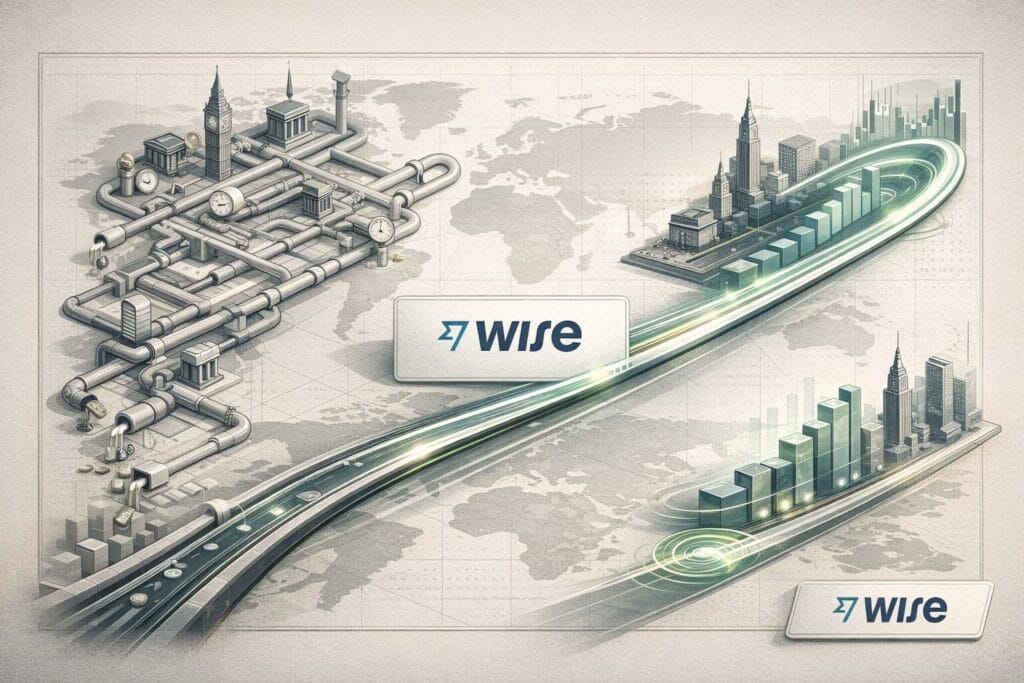
That last point matters because cross-border payments remain, by the standards of modern consumer finance, surprisingly primitive. A recent BIS paper noted that retail cross-border payments are still more costly, less accessible, slower, and less transparent than domestic payments, and that the global average cost of sending a $200 remittance in 2024 was still about 6%, only down from about 9% two decades earlier. Domestic payments in many markets have become close to instant and close to free. Cross-border money still too often behaves like a product from another era.
That gap is the real bull case for Wise. The company is not just competing with other apps on nicer design. It is trying to compress the difference between domestic and international money movement. On its platform pages, Wise says it now offers direct access to domestic payment systems in eight markets, covers more than 160 countries and 40-plus currencies, and gets 74% of payments completed in under 20 seconds and 96% in under 24 hours. Strip away the branding and what remains is a simple proposition: if users increasingly expect cross-border payments to work like local payments, the companies that own the new plumbing should have a long runway.
Wise is no longer just a transfer app.
This is where the company’s story has become more interesting than many casual observers realize. The old mental model was that Wise was mainly a cheaper remittance or FX-transfer service. The current numbers suggest something broader. In the latest quarter, customer holdings rose 37% to £29.4 billion, card and other revenue grew 29%, Wise Business active customers rose 26% to 572,000, and business cross-border volume grew 35% to £14.4 billion, materially faster than personal volumes. That is the profile of a company widening its relationship with users and moving up from transaction utility toward everyday financial operating layer.
That broadening matters because the best public fintechs are rarely one-product stories for long. They win by increasing frequency, deepening trust, and owning more of the workflow around money. Wise appears to be doing that in two directions at once: horizontally, by becoming useful for spending, receiving, saving, and business payments; and vertically, by selling its infrastructure to banks, financial institutions, and platforms. Its platform materials highlight integrations and partnerships with large institutions and say the business now operates with 70-plus licences worldwide. That does not make Wise a bank. It may be more valuable than that: a regulated network layer that banks and non-banks can plug into.
Why New York matters more than London would like.
Wise itself has been direct about the rationale. It says a primary U.S. listing would provide greater visibility in the United States, which it describes as its biggest market opportunity, along with better access to the world’s deepest and most liquid capital market. It will also begin reporting fiscal 2026 results in U.S. dollars under U.S. GAAP. Read together, those moves suggest something bigger than venue optimization. Wise is effectively arguing that the company should be priced, compared, and understood in the context of global payments and infrastructure, not simply as a British-listed fintech with an international footprint.
That is uncomfortable for London, but it is also revealing for the rest of fintech. The public-market question is no longer just whether tech-enabled finance can list successfully. It is which business models are legible enough to earn durable investor trust. A profitable cross-border payments network with rising business usage, falling prices, improving speed, and no urgent need for fresh capital is a much cleaner proposition than many of the consumer-finance stories that came to market in the zero-rate era. If even this model struggles to win a premium valuation, the message to the sector will be brutal. If it works, a lot of boards will start redrawing their IPO roadmaps.
The real risk is not whether Wise is good. It is whether the market fully understands what it is.
None of this makes Wise a risk-free story. The prospectus itself flags the concentrated voting power embedded in its dual-class structure, and says the company does not intend to pay dividends for the foreseeable future. Competition in international payments is still intense. Stablecoins, tokenized money, and new public-sector cross-border rails could also pressure fees over time. And because Wise keeps pushing prices down, it has to keep proving that network effects, customer growth, and product expansion can outrun yield compression.
But that is precisely why this listing matters. Wise is not asking Wall Street to believe in a vague future. It is asking the market to price a very specific proposition: that one of the biggest opportunities in global finance is still the unglamorous work of making money move across borders as easily as data already does. If investors agree, Wise’s Nasdaq debut will not just mark a new chapter for one company. It will signal that the next fintech cycle may belong less to the loudest brands than to the firms quietly rebuilding the rails underneath global commerce.